
2025 at Dataphyte: Looking Back, Looking Ahead

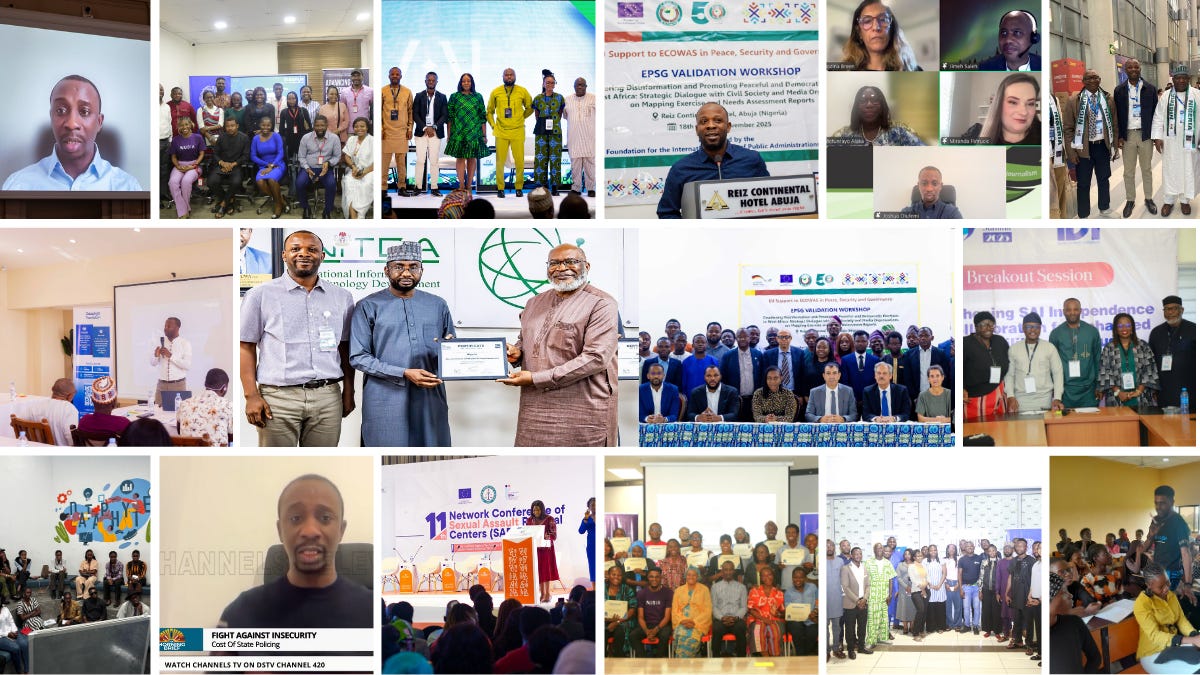
As we come to the close of another defining year for Dataphyte, I write with deep reflection, a sense of gratitude, and renewed conviction. Like many African organisations with global reach – especially civic technology hubs and public-interest research and reporting labs – that began locally and grew through trust and collaboration, our journey has been shaped by people and institutions who believed in the value of evidence, inclusion, and innovation. Dataphyte’s work as a think tank sits at the intersection of data integrity, digital trust, and development initiatives, and this year reaffirmed why that intersection matters.
In 2025, we delivered a high-impact mix of research, technology, and policy engagement that strengthened data-driven governance and civic accountability. The organisation produced 10 major research and policy advocacy outputs spanning gender equality, democratic governance, geopolitics, digital public infrastructure, security sector reform, and state policing. These efforts were supported by a strong editorial pipeline, with 139 weekly reports, 86 investigative and special reports, and 115 data visualisations, including interactive charts, Daily Data Cards, and geospatial maps.
Beyond publications, we implemented 9 major programmatic projects across community security, democratic accountability, ECOWAS peace and governance, digital rights and surveillance, women farmers’ data, biodiversity reporting, climate justice, and technology-facilitated gender-based violence. Across these initiatives, the organisation trained over 2,000 journalists, students, and civic actors through university tours, Data Story Labs, fellowships, and thematic workshops, while collecting and analysing more than 555 primary datasets across Nigeria’s 36 states and the FCT.
A defining feature of the year was the deployment of 5 core technology platforms: a real-time security observatory and analytics dashboard; interactive geospatial maps tracking insecurity and biodiversity; the new Dataphyte Insight platform; Goloka’s hyperlocal data and citizen feedback tools; and a live election blogging engine used during the Anambra 2025 election. These tools translated complex data into actionable public insights.
Dataphyte also played a direct role in policy influence and reform, contributing to the co-drafting of Nigeria’s Open Government Partnership National Action Plan IV, providing technical support that enabled NITDA to secure the Open Government Challenge Award, supporting ECOWAS peace and security mapping, and advancing evidence-based dialogue on digital governance, policing, and civic space protection. This work was amplified through structured multi-sector partnerships, engaging international donors, civil society organisations, media houses, federal government agencies, and universities to scale research, technology, and capacity-building outcomes across Nigeria and the wider region.
In 2025, we organised programmatically along a strategic FRAMEwork. To match our global transformative ideals with local sustainability ideas, we will continue to learn, to listen, and to evolve along this FRAMEwork in 2026 and the coming years:
Our thought leadership on Foreign Policy and National Security is evolving from episodic analysis to sustained intelligence that examines how diplomacy, trade, culture, technology, and democratic influence enhance national resilience. We are expanding our research on Nigeria’s relations with global and regional partners like the UNSC, BRICS+, and ECOWAS, viz-a-viz the Dataphyte Foreign Influence Index (FII) metrics and Foreign Partners Perception Surveys, focusing on how external engagements impact domestic stability– whether France’s cooperation on tax management or the US’ counter-terrorism support leading to the Christmas day episode. As geopolitical tensions rise, we aim to empower institutions, media, and civil society with evidence to foster constructive partnerships and mitigate destabilising interventions.
For Representation and Governance, we are mapping the relationship between political organisation and economic outcomes, monitoring ongoing tax reforms, political party fragmentation and coalition experiments to understand their effects on public trust. Dataphyte will create tools to improve tracking of civic participation in budget and planning cycles, making governance relevant and services accessible to citizens.
Our AI and Digital Futures initiatives have shifted from experimentation to infrastructure-building for the public good. Platforms such as Nubia.AI, Goloka.io and Anfani.org reflect our commitment to ethical AI, data sovereignty, and institutional capacity for digital support of transparency and accountability in the first and second sectors. As global debates intensify around AI governance and digital dependency, we aim to position African-led systems at the centre while remaining responsive to local realities and rights.
Under our Media Resources pillar, Dataphyte is expanding beyond newsroom technical support to building citizen and community media assets for information exchange and hyperlocal intelligence. As misinformation, insecurity, and platform dominance reshape the media landscape, we are doubling our efforts through fellowships with local radio stations and partnerships with grassroots stakeholders to strengthen reliable information exchanges that guide and guarantee public service delivery to communities.
On Environment, Energy, and Extractives, we are emphasising foreground ecological risk, local knowledge, and policy accountability within the global energy transition, leveraging findings from our Just Energy Transition (JET) Mineral project spanning Nigeria, Ghana, the Democratic Republic of Congo, and Mozambique. Through our climate data observatory and the development of an environmental reporting toolbox, we are equipping researchers, journalists and communities to document environmental change, extractive impacts, and energy choices. As climate pressures intensify and resource governance becomes more contested, we aim to produce evidence that supports sustainable development, safeguards vulnerable ecosystems, and aligns environmental policy with long-term economic resilience.
To our Board of Trustees and Editorial Advisory Board, thank you for your stewardship, intellectual rigour, and principled guidance. Your counsel continues to sharpen our thinking and anchor our work in integrity. To our funders, whose confidence sustains both experimentation and impact, we are grateful for your long-term vision and your willingness to support work that does not always offer easy answers, but always seeks truthful ones. Your partnership has enabled Dataphyte to remain independent, credible, and bold.
We extend sincere appreciation to our local and international partners in government institutions and embassies, who have engaged our research, data platforms, and policy insights with openness and professionalism. In a time when trust in public information is fragile, your collaboration has helped ensure that data is not merely collected but responsibly interpreted and meaningfully applied.
Our thanks also go to civil society organisations who have worked with us to translate complex datasets into advocacy, accountability, and community action. We also acknowledge the media – editors, reporters, and platforms – who continue to amplify our work, challenge our assumptions, and collaborate with us to tell data-informed stories that matter. Together, we have demonstrated that rigorous analysis and compelling storytelling can coexist, and that data can serve governance and democracy when placed in the hands of responsible journalists and informed citizens.
To schools, colleges, and young professionals across Africa and beyond who have participated in our training programmes, fellowships, and collaborative projects: you are central to Dataphyte’s mission. Much like other globally connected African organisations that invest in capacity building as a pathway to systemic change, we believe the future of data-driven public interest work lies in nurturing critical thinkers and ethical practitioners. Your curiosity, questions, and commitment inspire us.
As we look to the new year, our aspiration is clear. Dataphyte will deepen its role as a trusted partner in evidence-based decision-making, expand cross-border collaborations, and invest further in innovative tools that make data more accessible and actionable. We aim to strengthen our presence in artificial intelligence, policy-relevant research, women’s economic empowerment, resource governance accountability, investigative data journalism, electoral integrity, and data-led hyperlocal community interventions, while remaining adaptive in a rapidly changing information ecosystem.
On behalf of the entire Dataphyte team, thank you for walking this journey with us. The year ahead calls for courage, collaboration, and clarity of purpose. We step into it with optimism, grounded in our shared values, strengthened by our partnerships, and committed to using data in service of the public good.
Joshua Olufemi
Founder & CEO, Dataphyte