

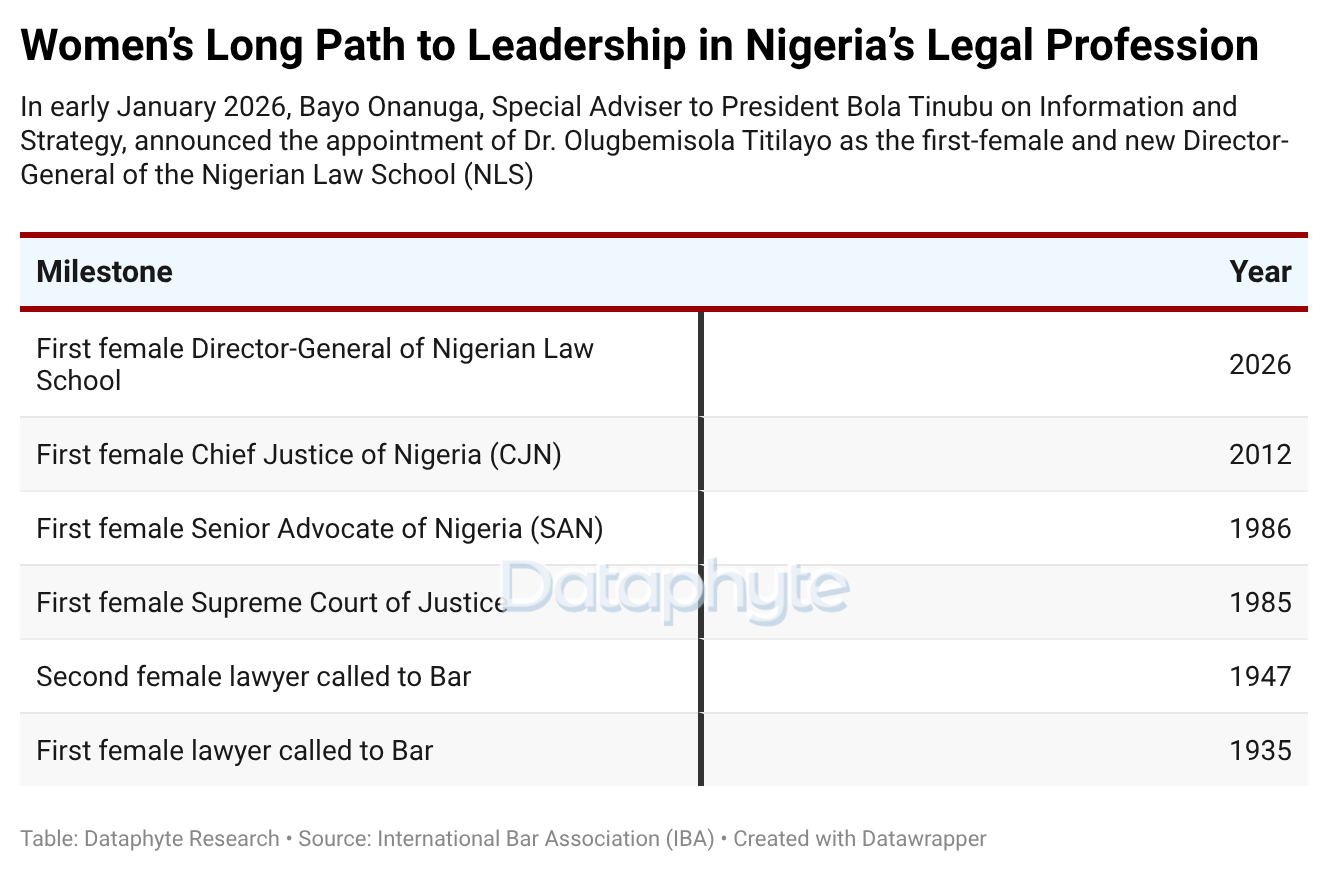
In early January 2026, Bayo Onanuga, Special Adviser to President Bola Tinubu on Information and Strategy, announced the appointment of Dr Olugbemisola Titilayo as the new Director General of the Nigerian Law School. Her appointment, which took effect on January 10, 2026, is for a four-year term and makes her the first woman to lead the institution since its establishment in 1962.
As the statutory body responsible for training and certifying prospective lawyers in Nigeria, the Nigerian Law School occupies a critical gatekeeping role within the legal profession. Its leadership shapes not only the structure of legal education but also the pipeline through which lawyers are admitted to the Bar each year.
While Olugbemisola’s appointment represents a breakthrough in institutional leadership, it also draws renewed attention to longstanding gender disparities within Nigeria’s legal profession. Although women now constitute a significant proportion of law graduates and newly called lawyers, their presence declines sharply at higher levels of professional authority. From senior advocacy and judicial appointments to leadership positions within legal institutions, women remain underrepresented, revealing a gap between participation and power that extends beyond individual milestones and reflects deeper structural inequalities within the legal system.
The journey of women in Nigeria’s legal profession has been slow and uneven, highlighting the challenges they face in attaining positions of power. Although women began entering the Bar as early as the 1930s, it took decades before they started holding senior roles, such as judges, leaders of professional associations, or heads of major legal institutions. Today, despite more women graduating from law schools and being called to the Bar each year, their presence in top positions is somewhat limited.

Explore Our Publications
We release in-depth research publications and publish compelling data-driven reports on a wide range of topics.