

If it feels like everyday expenses have risen sharply in the past few years, that perception is widely shared. Many households report that the same basket of groceries now accounts for a much larger share of their income than it did in 2020.
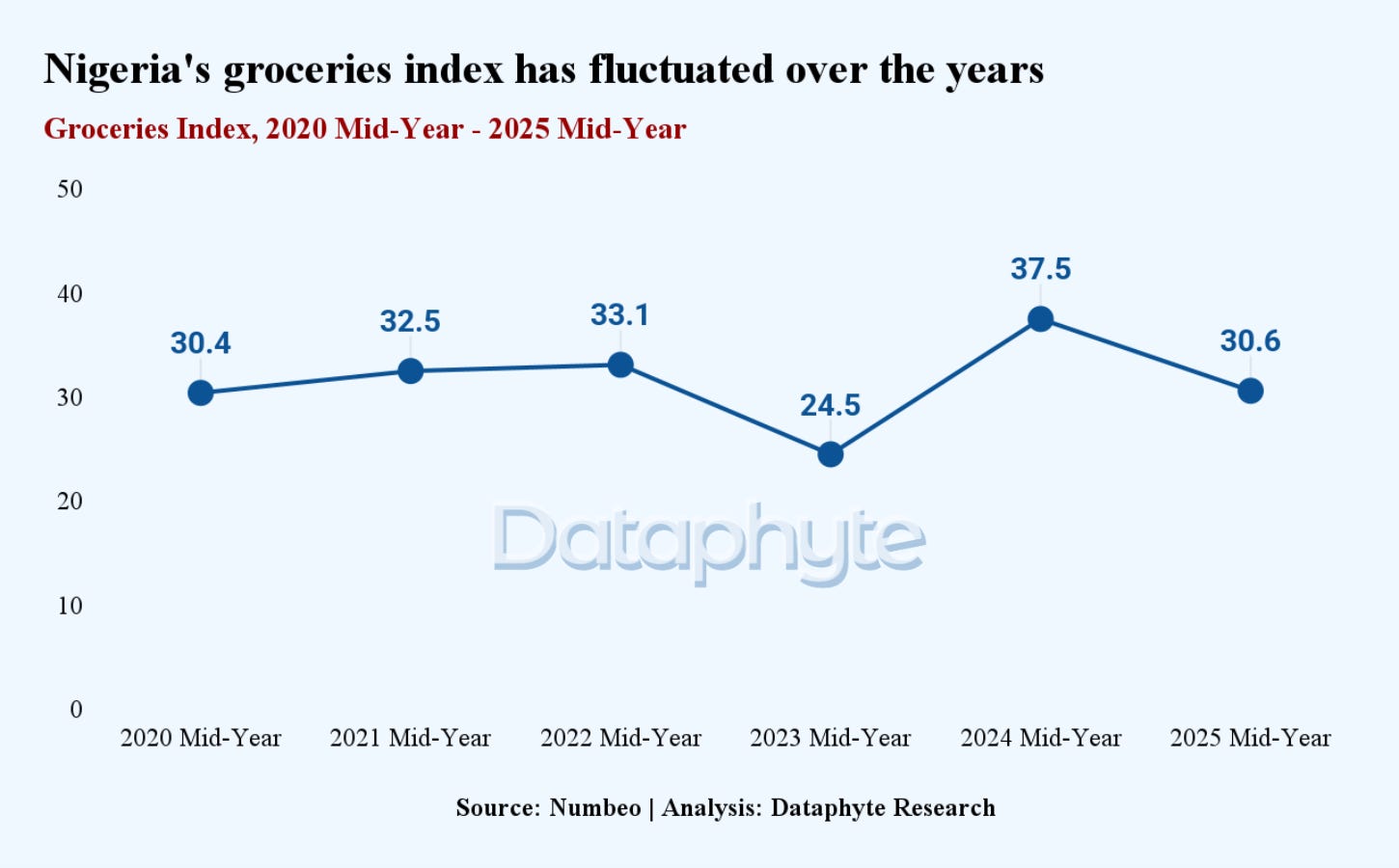
However, one widely cited benchmark appears to tell a different story. Nigeria’s score on the Numbeo Groceries Index moved only marginally from 30.4 in mid-2020 to 30.6 in mid-2025. On the surface, this suggests that grocery prices, at least in relative terms, have remained broadly stable over that period.
This apparent disconnect between perception and index data raises an important question: are prices truly stable, or does the measure reflect something different from the day-to-day reality of domestic consumers?
The lived reality of these price pressures has been a central topic among netizens. On X (formerly Twitter), user Olabode Ifeanyi drew attention to how inflation has quietly reshaped household expenses, arguing that any worker whose salary had not increased sixfold since 2020 had effectively become poorer.
His post compared the total cost of the same basket of grocery items purchased in 2020 and again in 2026, illustrating the scale of price escalation. According to the figures shared, the total cost rose from N25,225 in 2020 to N147,050 in 2026, a 582% increase.
The viral comparison shared on X highlights nominal price increases for specific household items, which may better reflect the lived experience of inflation. Therefore, the contradiction between the modest change in Numbeo’s index and the sharp rise in actual grocery bills suggests that relative price indices may not fully capture the decline of domestic purchasing power.

Explore Our Publications
We release in-depth research publications and publish compelling data-driven reports on a wide range of topics.